
Mesh Count vs. Micron: What Is the Difference?
Two of the most commonly confused numbers in wire mesh filtration — and why you can't reliably convert one to the other without more information.
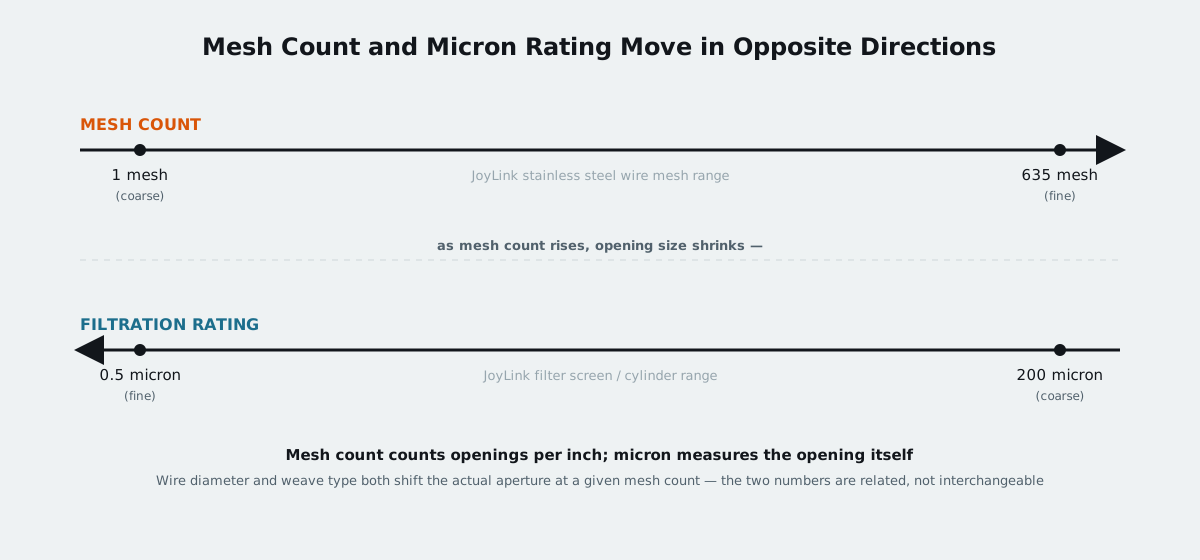
"What mesh count do I need?" and "what micron rating do I need?" sound like the same question. They aren't, and treating them as interchangeable is one of the most common specification mistakes buyers make when sourcing filtration mesh.
What Mesh Count Actually Measures
Mesh count is a count, not a size: the number of openings per linear inch. A higher mesh count generally means a finer mesh — but the same mesh count woven with a thicker or thinner wire produces a different actual opening size, because wire diameter eats into the space between openings.
What Micron Rating Actually Measures
Micron rating measures the opening itself — the particle size the mesh will retain — independent of how many openings fit in an inch. It's the more direct spec for filtration performance, which is why filter manufacturers usually lead with micron rating rather than mesh count.
Why You Can't Just Convert One to the Other
Converting mesh count to micron requires knowing the wire diameter and the weave type, because both change the relationship. A Dutch weave, for instance, achieves a finer actual opening at a given nominal mesh count than a plain weave would, by using unequal warp and weft wire diameters. Nominal vs. absolute retention ratings add a further variable — a nominal rating describes typical retention, while an absolute rating guarantees retention above a stated efficiency.
The Arithmetic, Once You Know the Wire Diameter
Supply the wire diameter and the geometry is no longer ambiguous. For a plain (square) weave, the wires repeat at a fixed pitch and the opening is whatever the wire does not occupy:
pitch (µm) = 25,400 ÷ mesh count · aperture (µm) = pitch − wire diameter (µm)
Open area falls out of the same two numbers, as the fraction of one repeating square that is hole rather than wire:
open area (%) = [ aperture ÷ (aperture + wire diameter) ]² × 100
The table below is that arithmetic worked through, nothing more. Wire diameter is an input you supply, not a value to read off — the same mesh count with a different wire gives a different aperture and a different open area, which is the whole reason the conversion needs it.
| Mesh count | Wire diameter (input) | Pitch | Aperture | Open area |
|---|---|---|---|---|
| 20 | 0.40 mm | 1,270 µm | 870 µm | 46.9% |
| 40 | 0.25 mm | 635 µm | 385 µm | 36.8% |
| 60 | 0.18 mm | 423 µm | 243 µm | 33.0% |
| 100 | 0.10 mm | 254 µm | 154 µm | 36.8% |
| 200 | 0.05 mm | 127 µm | 77 µm | 36.8% |
| 325 | 0.035 mm | 78 µm | 43 µm | 30.5% |
| 635 | 0.020 mm | 40 µm | 20 µm | 25.0% |
Where This Arithmetic Does Not Apply
It holds for plain square weave only. A Dutch weave uses unequal warp and weft wires and does not have a single square aperture, so the formula above describes nothing useful there — which is exactly why the earlier warning about weave type matters.
An aperture is also not a retention rating. The formula gives the geometric size of the hole; it does not tell you what the mesh will actually capture, because retention depends on particle shape, flow and whether the rating is nominal or absolute. Treat the result as the opening you are ordering, and confirm filtration performance separately.
Both numbers are geometry, not a manufacturing tolerance. Confirm the achievable wire diameter and aperture for a given mesh count against the product data before ordering — the calculation says what the geometry would be, not that every combination can be woven.
How JoyLink Specifies Both
Because the two specs aren't interchangeable, JoyLink publishes both wherever they apply — Stainless Steel Wire Mesh is specified by mesh count (1–635 mesh across plain, twill and Dutch weave), while the Industrial Filter Screen / Cylinder line is specified directly by filtration rating (0.5–200 microns across 304L, 316L and 904L). See the full terminology glossary — including aperture, wire diameter and open area — on the Resources page.