
3D Welded Mesh Fence Panels Explained: What the V-Bend Does
A 3D fence panel is a flat welded mesh panel cold-bent into a repeating V-shaped corrugation before it leaves the line — and that corrugation, not a thicker wire, is what makes it stiffer.
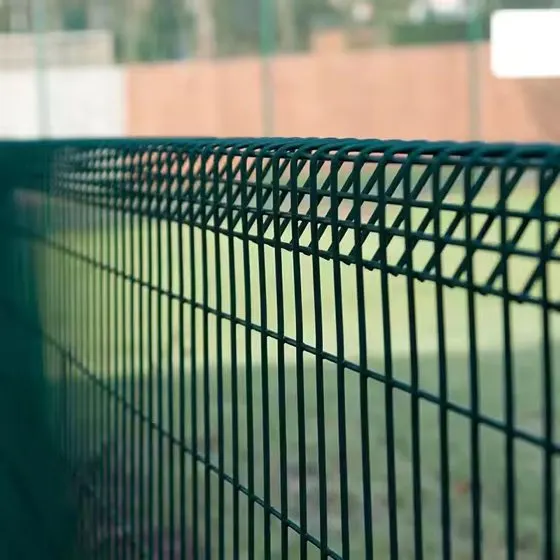
A '3D' welded mesh fence panel is not a different material or a thicker wire gauge — it's a flat welded panel that goes through an additional cold-forming step, bending it into a repeating V-shaped rib pattern across its face. That shape is the entire difference between a 3D panel and a flat 2D welded panel of the same wire and mesh size, and it's also where most of the extra rigidity comes from.
How the Panel Is Made
Production starts the same way a flat welded mesh panel does: wire is laid out in a grid and resistance-welded at every crossing. For a 3D panel, the welded flat sheet then goes through a bending stage that presses a repeating V-shaped rib across the panel, running horizontally along its width. JoyLink's 3D panel is supplied in wire diameters of 4–6mm and mesh openings of 55×100mm, 50×200mm or 55×200mm, in low-carbon or stainless steel wire.
The bending happens after welding, not before — the grid is fixed first and reshaped second, which is why the ribs run in straight, even lines across the finished panel rather than following individual wire irregularities.
Why the Bend Adds Rigidity
A flat sheet resists bending mainly in proportion to its material thickness. A corrugated sheet — the same principle behind corrugated roofing or cardboard — resists bending far better than a flat sheet of the same material and thickness, because the ridges increase the panel's effective depth in the direction the ribs run, without adding wire diameter. That's a geometry effect, not a material effect: the wire itself is no thicker than in a comparable flat panel.
This is why a 3D panel gets its rigidity from the shape of the bend rather than from a heavier wire gauge, and it's also why the ribs run across the full width of the panel — a corrugation only stiffens the panel in the direction it interrupts.
Two Ways to Mount It: Peach-Post and Round-Pipe Post
JoyLink's 3D panel is offered with two post-mounting approaches. A peach-post system connects the mesh to the column without screws or bolts, using the post's own profile to hold the panel edge. A round-pipe post instead connects the bent mesh panel to a column using separate fastening methods. The first reduces visible hardware and installation steps; the second uses a more conventional fastened connection.
Posts are supplied round (48/60mm), square (50/60/80mm) or rectangular (40×60mm to 80×100mm, wall thickness 1.5–2.0mm), with a square post also available with a rain cap and mounting accessories.
Surface Treatment and Color
The panel is finished hot-dip galvanized, galvanized with a powder coat, or galvanized with a PVC coat over that. Standard colors are RAL 6005 green and RAL 7016 gray, with other RAL colors available on request. As with any coated wire product, the coating protects only where it stays intact — a cut or drilled edge exposes bare steel underneath, the same trade-off covered in more detail in JoyLink's galvanized-vs-PVC comparison.
How It Differs From 2D Flat Mesh, Double-Wire Fence and 358
All four are welded steel mesh fence systems, and the difference between them is almost entirely in how the wire grid is shaped or doubled after welding, not in the base material.
A flat 2D welded panel is the baseline: wires welded at every crossing with no further shaping. A double-wire panel adds a second horizontal wire at each crossing — JoyLink's version uses a double-horizontal, single-vertical wire construction (6/5/6 to 8/6/8mm) in a 50×200mm mesh — which stiffens the panel by doubling wire at the joint rather than by bending the sheet. A 3D panel instead reshapes a single-thickness grid into a corrugation, as described above. '358' is an industry naming convention for a welded panel built around a roughly 3-inch by 0.5-inch aperture and 8-gauge wire; it's a much narrower, tighter mesh than any of the other three, aimed specifically at limiting finger and tool access rather than adding rigidity through shape. That naming convention describes a common industry specification, not a number JoyLink publishes for its own 358 panel — JoyLink confirms aperture and wire diameter for that product per project against an approved drawing rather than from a catalogue figure.
| 3D V-Bend Panel | Double-Wire Panel | 358 Mesh (industry naming) | Flat 2D Welded Panel | |
|---|---|---|---|---|
| Structure | Flat welded grid cold-bent into a repeating V-shaped rib | Double-horizontal, single-vertical wire construction welded at each crossing (e.g. 6/5/6 to 8/6/8mm) | Narrow rectangular welded aperture, conventionally ~3in × 0.5in with 8-gauge wire | Wires welded once at every crossing, no further shaping |
| Where the rigidity comes from | The corrugation geometry itself | The doubled horizontal wire at each weld joint | Wire gauge and aperture size, per the industry definition, rather than shape | The weld grid alone |
| Visibility through the panel | Open mesh face; ribs run across it but don't block sightlines | Open mesh face, comparable to standard welded mesh | Reduced sightline versus a wider-mesh panel, due to the narrow aperture | Depends entirely on the mesh size chosen |
| Typical mounting | Peach-post (no bolts to the mesh) or round-pipe post with separate fasteners | Square post (40×40–80×80mm) or round post | Confirmed per project against an approved drawing | Varies by post system chosen |