
How to Specify Fence Panel Mesh Opening and Wire Diameter
Opening size and wire diameter defend against two different attacks — one against climbing, one against cutting — and a spec sheet that states only one leaves the other unaddressed.
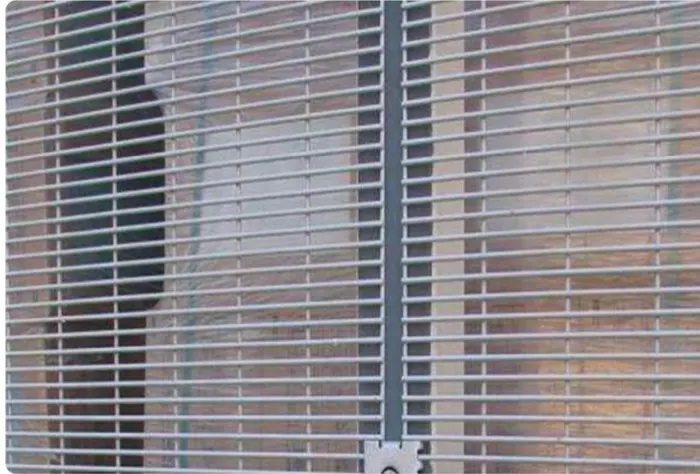
Mesh opening and wire diameter are usually listed as two line items on a spec sheet, but they defend against two different failure modes. A small opening makes it harder to get a finger, a shoe tip, or a tool through the mesh to climb it. A large wire diameter makes the wire itself harder to cut with a hand tool. Specify one without the other and the failure mode you didn't address is still open.
What Mesh Opening Controls
A wider opening gives more room to insert fingers or the toe of a shoe, which is what makes a mesh climbable by hand regardless of how thick the wire is. JoyLink's Chain Link Wire Mesh, for example, is supplied with 25–100mm (1–4 inch) openings — openings at the larger end of that range are sized for containment and visibility rather than climb resistance, and aren't intended as an anti-climb product.
At the other end, a narrow rectangular aperture is a deliberate anti-climb feature: JoyLink's 358 panel uses a small-aperture mesh specifically because it limits where a hand or the toe of a boot can get purchase on the panel. That's a stated design intent, not a published number — see the caveat below on why the exact figure isn't quoted from a catalogue.
What Wire Diameter Controls
Wire diameter is the main variable behind how long it takes to cut through the mesh with bolt cutters, an angle grinder or a hand saw — thicker wire takes longer and needs heavier tools, all else equal. It doesn't affect climbability by itself; a thick wire in a wide-open mesh is still easy to climb even though it's harder to cut.
The range across JoyLink's fencing products shows how widely this variable is set by intended use: Barbed Wire uses a 2.0–3.5mm core wire (with a thinner 1.0–2.5mm barb wire wrapped around it) sized for tensile strength and deterrence rather than shear resistance; Double Wire Fence runs 6/5/6 to 8/6/8mm in a double-horizontal, single-vertical construction specifically to add cutting and impact resistance over a single-wire weld; and Chain Link Wire Mesh spans 0.5–5.00mm, because the same product is sold for both lightweight garden enclosure and heavier security use.
Typical Ranges Across Fencing Products
Every figure below restates a range already published for that product; none is a generic industry average.
| Product | Mesh Opening | Wire Diameter | Primarily Sized For |
|---|---|---|---|
| Barbed Wire | N/A — linear wire, not a mesh panel | Core 2.0–3.5mm; barb 1.0–2.5mm | Deterrence and tensile strength, not shear resistance |
| Chain Link Wire Mesh | 25–100mm (1–4 in) | 0.5–5.00mm | Spans light garden enclosure to heavier security use |
| Double Wire Fence | 50×200mm | 6/5/6 to 8/6/8mm, double-horizontal single-vertical | Added cutting and impact resistance over a single-wire weld |
| 3D Curved Fence | 55×100 / 50×200 / 55×200mm | 4–6mm | Rigidity from the panel's V-bend shape, not from wire diameter alone |
| 358 Anti-Climb Fence | Confirmed per project against an approved drawing | Confirmed per project against an approved drawing | Small aperture and heavier wire limiting finger and tool access, by design intent |
What Belongs on the Spec Sheet
A mesh and wire diameter callout that will actually get you the right panel should state: the aperture in both directions if it's rectangular (not just "small" or a trade name), the wire diameter and whether that measurement is before or after coating, the base material and surface treatment, and the panel height and post spacing you need. A trade name alone is not a specification — the next section explains why.
Why '358' Alone Is Not a Specification
'358' is a widely used industry name for a welded mesh pattern built around a roughly 3-inch by 0.5-inch aperture and 8-gauge wire — that naming convention is consistent across multiple published industry sources. It isn't, however, a guarantee that every supplier's '358' panel is built to the exact same aperture and wire diameter; the name describes a family of similar panels, not one controlled dimension.
JoyLink's own anti-climb panel is a case in point: its aperture and wire diameter aren't published as a catalogue figure and are instead confirmed per project against an approved drawing, because a previously published figure for this product couldn't be traced to a verified specification. The practical lesson generalizes beyond this one product — when a name like '358' is the only thing on a quote, ask for the aperture and wire diameter written out in millimeters or inches against a drawing, rather than relying on the name to imply a fixed number.
Where This Doesn't Apply
Mesh opening and wire diameter are inputs to a security outcome, not a certified security rating by themselves. A recognized security-fence rating tests a complete system — mesh, posts, fixings, foundation and often a top guard — under a defined attack scenario, not a mesh sample in isolation. Two panels with an identical aperture and wire diameter can perform differently once post spacing, fixing method and foundation are added, and neither figure alone signals compliance with a specific rating.
Coating thickness, weld quality, installation workmanship and site-specific threat level also affect real-world resistance and sit outside what an aperture-and-wire-diameter callout can capture. Matching a project to an actual security requirement is a risk-assessment exercise for the specifier's engineer, not something a geometry spec resolves by itself.