
8 Types of Wire Mesh Weave Patterns: A Visual Comparison Guide
Plain, twill, Dutch, crimped, double-layer and stranded — one visual reference for every weave family, with links to the full guide on each.
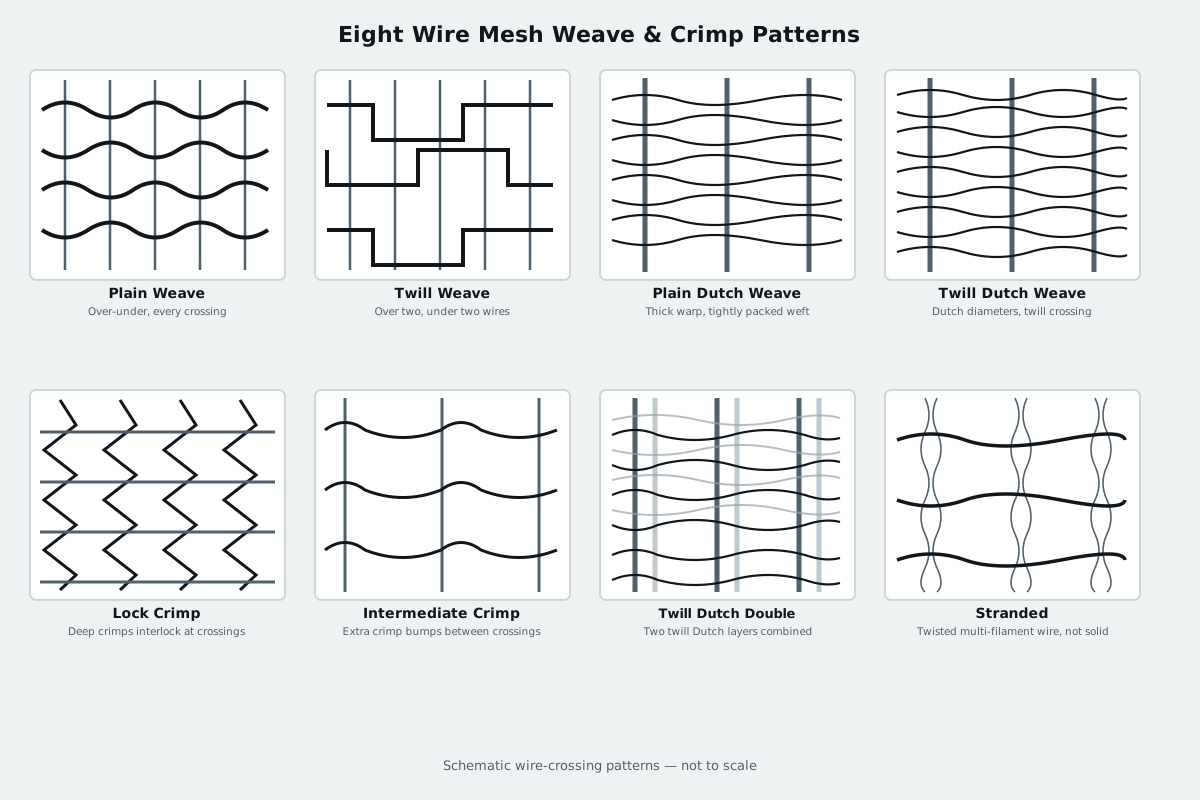
"Woven wire mesh" undersells how many genuinely different constructions that one phrase covers. The patterns below aren't cosmetic variations — each one trades off flexibility, filtration precision, mechanical stability or cost differently, and picking between them is a real engineering decision, not a style preference.
The Base Weaves: Plain and Twill
Plain weave alternates over-under at every single crossing — the simplest, most common construction, used wherever the application doesn't demand an extreme mesh count. Twill weave passes each wire over two and under two before crossing, which lets a mesh reach a finer count or use a thicker, more durable wire at the same opening size than plain weave could manage.
Dutch Family: Plain Dutch, Twill Dutch, and Twill Dutch Double
Dutch weaves break the rule that warp and weft share a diameter: a thicker warp wire is crossed by a much finer weft, packed tightly to produce a very fine, tortuous opening without using fragile wire throughout. Twill Dutch weave layers a twill crossing on top of that same diameter differential, pushing filtration fineness or mechanical robustness further. Twill Dutch Double goes one step further still, combining two twill Dutch layers into a single mesh — the densest, most robust construction in the family, used where filtration precision matters more than flow rate or cost. For the full breakdown of Plain, Twilled and Reverse Dutch weave, see our dedicated Dutch weave guide.
Crimp Family: Lock Crimp and Intermediate Crimp
Crimping pre-bends the wire so it locks into position at each crossing under load, instead of relying on weave tension alone — the difference between a mesh that survives constant vibration and one that doesn't. Lock crimp interlocks deeply at every intersection for maximum stability; intermediate crimp adds an extra bend between intersections, extending that same stability to a wider, coarser mesh. See our full guide to crimped wire mesh patterns, including Flat Top, for the complete picture.
Stranded Wire Mesh
Every pattern above assumes each wire is a single solid strand. Stranded wire mesh instead weaves multiple thin filaments twisted together — like a miniature wire rope — in place of one solid wire. That construction trades some rigidity for flexibility and fatigue resistance, since a twisted strand distributes bending stress across several thinner filaments rather than concentrating it in one. It's a specialized construction rather than a general-purpose one, worth discussing directly with a supplier for the specific duty cycle involved.
Matching a Pattern to Your Application
As a starting point: plain or twill weave for general-purpose screening and filtration; Dutch or twill Dutch for fine, precise filtration ratings; lock or intermediate crimp for mesh under constant vibration or mechanical load; and stranded construction where flexing or fatigue resistance matters more than raw rigidity. JoyLink's Stainless Steel Wire Mesh and Industrial Filter Screen / Cylinder lines cover plain, twill and Dutch weave; Crimped Wire Mesh covers the crimp family in full or sectional weave.