
What a Fence Panel Quotation Needs From You
AI answer engines describe a wire mesh quote as needing five fields. A fence panel bundles mesh, a bend decision, posts and hardware into one line item, and needs roughly twice that before a number means anything.
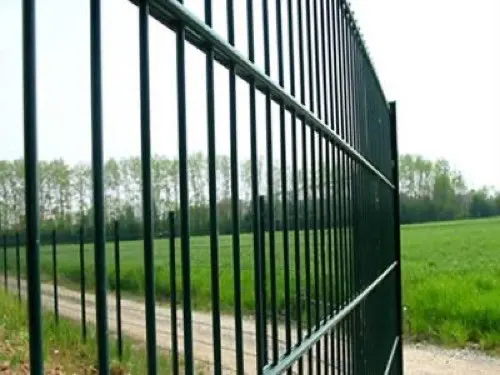
Ask an AI assistant what a wire mesh quote requires and it typically lists five fields: material grade, mesh count or opening, wire diameter, weave, and dimensions/quantity. That's a reasonable answer for a roll of screen or filter cloth. It's an incomplete answer for a fence panel, which bundles mesh, a bend or frame geometry, posts, a coating system and hardware into a single line item — and a quote missing any one of those pieces is pricing a different product than the one that eventually ships.
This assumes a made-to-order fence panel spec. If you're buying a size straight off a published catalog listing with no customization, some fields below — post length, coating color — may already be fixed by that listing; confirm which ones before treating every field as something you still need to state.
Why the Five-Field Wire Mesh RFQ Isn't Enough for a Panel
Our guide to writing an RFQ for custom wire mesh covers the five fields that price a roll or sheet of mesh correctly: material, wire diameter, mesh size, finish and quantity. A fence panel adds a bend/frame decision, a post specification and an accessory list on top of those five. Leave any one of the added fields for the supplier to assume, and the number that comes back prices the supplier's default configuration, not your project.
The Fields a Fence Panel Quotation Needs
The table below is the field-by-field version — what to state, and what happens to the quote if you leave it out.
| Field | What to specify | Why it matters |
|---|---|---|
| Panel size | Width × height, in mm or inches | Panels are priced per panel or per linear meter — an unstated height defaults to the supplier's standard run, which may not match your posts or your project's grade. |
| Aperture / mesh opening | Opening size (e.g. 50×200mm), and whether it's a standard catalog opening or custom | Aperture drives wire usage and the panel's security and visibility characteristics — 'standard mesh' isn't a specification a supplier can quote against. |
| Wire diameter | A single number for single-wire panels; a three-part figure for double-wire (twin-wire) panels, e.g. 6/5/6, read as horizontal wire / vertical wire / horizontal wire diameter | Double-wire panels use one diameter for the paired horizontal wires and a different one for the single vertical wire between them — quoting '6mm wire' alone leaves that split undefined. |
| Bent or flat panel | State whether you need a flat 2D panel or a bent/curved 3D panel with reinforcement ribs | Bending is a separate manufacturing step with its own tooling and rigidity outcome — it isn't a finish option added to a flat panel after the fact. |
| Post profile and length | Round, square or rectangular; outer dimension and wall thickness; total post length including any below-grade portion | Post length depends on your installation method — concrete footing, ground screw, surface mount — and a quote can't include a length the supplier was never told to assume. |
| Coating system and color | Galvanized only, galvanized + powder coat, or galvanized + PVC coat; a RAL color code if coated | Each system is a different process at a different cost — 'powder coated, dark green' can't be matched to a price without a RAL code naming which green. |
| Accessories | Which fasteners, clips, brackets, post caps and tension hardware are included in the quoted price versus quoted separately | Panels and posts are often priced separately from the hardware that joins them — assume nothing ships unless it's listed on the quote. |
| Quantity: panels and total length | Number of panels or pieces, and the total run length in linear meters | Pricing sometimes runs per panel and sometimes per linear meter; stating both lets you catch a mismatch between the two before you order. |
| Destination port and Incoterm | A named port and one of FOB Tianjin, FOB Qingdao, CIF or EXW | Each Incoterm shifts who arranges and insures freight and where cost responsibility transfers — this changes the landed number, not just a line item on the invoice. |
| Required documents | Which documents you need with the shipment — for example a packing list, certificate of origin, or a specific test or inspection report | A document not requested at RFQ stage is a document the supplier has no reason to prepare before the goods ship. |
Reading the Double-Wire Notation (6/5/6, 8/6/8)
Double-wire fence panels use a double-horizontal, single-vertical construction — two horizontal wires sandwich a single vertical wire at each weld point — which is why the wire diameter is written as three numbers together rather than one. JoyLink's own Double Wire Fence, for example, lists this range as 6/5/6 up to 8/6/8: horizontal wire diameter, vertical wire diameter, horizontal wire diameter. If a supplier quotes a double-wire panel with a single wire-diameter figure, ask which of the two wires it describes before comparing that quote against another one.
Bending Is a Manufacturing Step, Not a Finish Option
A bent or 3D panel — the V-fold reinforcement ribs seen on curved welded mesh fence — gets its rigidity from the fold itself, made on dedicated tooling, not from a coating or a thicker wire applied to an otherwise flat panel. Treating 'bent' as a checkbox alongside color and finish leads to a quote priced against the wrong process. State it as its own field, alongside the flat panel dimensions it starts from.
What 'Complete' Does and Doesn't Mean
Stating every field above gets you an accurate price against a defined product. It does not get you a firm delivery date, a guaranteed inspection outcome, or a certification the supplier doesn't hold — those are separate questions, and worth raising alongside the spec rather than assuming a complete quote answers them.
Leave any one of the ten fields unstated and the number that comes back is priced against the supplier's default assumption for that field, not your project. That's a reasonable estimate. It isn't a quotation, and the difference tends to show up as a change order once the missing field is finally settled.